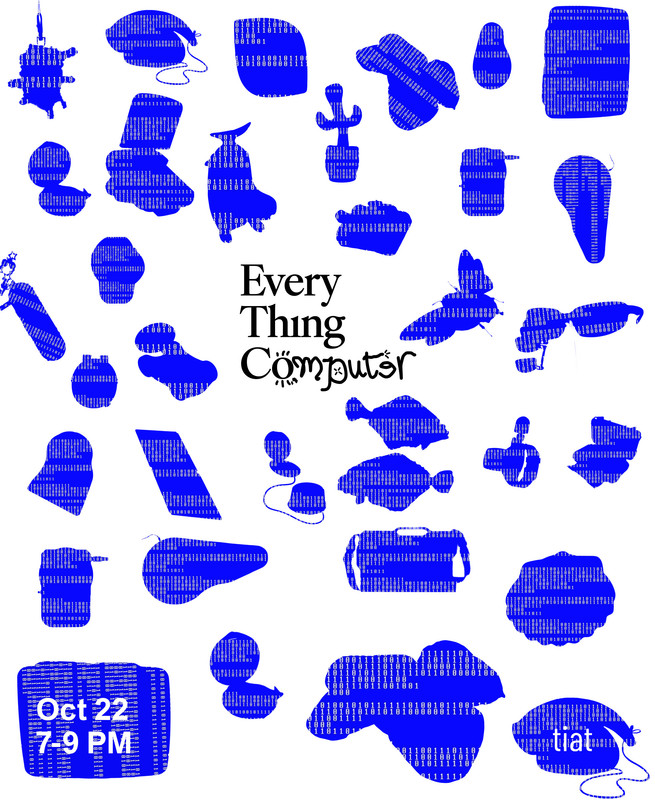
Every Thing Computer
An exhibition of playful computing and experimental interfaces, exploring tactile, physical, social, and expressive relationships with machines.
About the Exhibition
Computing reaches into nearly every part of our lives, but its everyday gestures remain familiar: tapping glass, typing on keyboards, and issuing prompts. Every Thing Computer opens up other possibilities.
Artists, designers, and technologists turn computation into something visitors can hold, wear, play, listen to, and encounter together. Through unexpected objects and experimental interfaces, the exhibition considers how machines might make room for intimacy, ritual, humor, curiosity, and expression.
Visit October 23 – November 18, 2026 at tiat, 151 Powell St, San Francisco. Gallery hours: Thursday and Friday, 2–6 pm; Saturday, 12–5 pm. Join us for the opening reception on October 23.
This exhibition is supported by Era.
Artworks
iwanttogotothemall.com
Pao is an illustrator and artist from Tijuana, Mexico. She is a Rhizome Microgrant recipient, a RisoLAB Artist-in-Residence, and alum from the School of the Museum of Fine Arts at Tufts University. Their work depicts cultural imperialism on the internet, melodrama, obsession, and the border between scary and cute.
iwanttogotothemall.com is a web browser game interpreting the American shopping mall as a symbol for the US-Mexico border. The internet, the shopping mall, and the border become one: a focal point for surveillance, assimilation, and imperialism, covertly achieved through cute aesthetics. Inspired by the virtual world tie-ins of mall chains like Build-a-Bear-Workshop, this object is a warning for my younger self. Through gaudy games, I tell her going to "the mall" is a bad idea.
Find My Friend
Queenie Wu is an artist, technologist, and researcher investigating how locative media inform our relationships and memories of shared surroundings. Through cartography, writing, curation, workshops, and activations spanning the digital, physical, and interactive, she expands on the connections between place, play, and poetics.
Hardened by UWaterloo Systems Design Engineering, and softened by NYU Interactive Media Arts, her work has been supported by the Steve Jobs Archive, NEW INC, All Street Gallery, and the HTML Review.
Find My Friend is a pair of compasses that have been wired to point its arrow not towards north, but toward its other half.
Using GPS outdoors, and UWB indoors, the compasses share their coordinates, and calculating a bearing in relation to its partner coordinate for a stepper motor, connected to an arrow.
Our modern navigation devices have atrophied not only our sense of how get somewhere, but also sense of where we should go and why. Instead of navigating towards an endpoint, this work, and its accompanying documentation presents and asks how it would feel if we could only orient ourselves towards the person that can make any place meaningful.
Tree of Knowledge?
Doug McCune is a recovering software developer turned sculptor. He now makes physical things that live in the physical world that you can hold in your physical hands. His sculptures touch that part in the back of your brain that knows there’s something not quite right with the path we’re on.
Our devices hold more and more of humanity’s knowledge and yet less and less humanity. Is the world becoming nothing but disembodied limbs holding cell phones?
The Soft Computer Mini (Travel Edition)
Yafira Martinez is a design engineer, creative technologist, and artist with a master's degree from the Interactive Telecommunications Program (ITP) at NYU's Tisch School of the Arts and a B.S. in Computer Science. Her work sits at the intersection of hardware, software, and interaction design, spanning physical computing, embedded systems, soft electronics, and poetic computation: generative text, experimental interfaces, and systems that behave in unexpected ways. Through her independent practice, Electrocute Lab, she explores open-source creative engineering, using textile-based electronics and soft circuits to bridge craft and computation, questioning how the design of technology shapes human experience. Driven by curiosity and tactile experimentation, she believes machines can be tender.
The Soft Computer Mini is a portable, laptop-sized textile computer that treats computing as craft. Touch the felt flower trackpad to wake it, press one of six mood keys (care, dream, craft, code, bloom, void), then the machine-knit space bar, and the e-ink screen composes a one-of-a-kind tarot card, one of about 39,000. A travel-sized extension of The Soft Computer, it draws on computational poetics and alternative interfaces to challenge optimization and turn interaction into ritual.
I <3 My Computer
Jana Yan is an artist working across sculptural installations, interactive objects, and two-dimensional works. Drawing on everyday behaviors and items, she weaves in personal experience and cultural memory to build immersive settings that invite the audience to interact. She is currently pursuing a BFA in Studio Art, with a second major in Computer Science, at Washington University in St. Louis.
My computer has been my closest; it may know me better than anyone. It knows me by heart. This soft silicone screen asks for no typing or tapping, only your pulse. Put your finger on the sensor and each heartbeat lights up one pixel, slowly tracing the shape of a heart, The piece makes visible the quiet trust we place in our devices: we hand them our softest, most involuntary selves, and they redisplay us, tenderly and in public.
Tallygotchi
Ally B is an Industrial Designer based in Zürich, Switzerland. Her work brings together fashion, technology, and craftsmanship, transforming familiar objects into unexpected wearable pieces. Drawing on nostalgia and a fascination with tactile experiences, she explores the personal connections we form with the things we own.
Tallygotchi reimagines the Japanese virtual pet Tamagotchi as an oversized handbag. The piece brings our emotional attachment to technology into a new context, blurring the line between technology and accessory. By turning an electronic toy into a fashion accessory, it raises a broader question about the role of technology in our lives: How can the devices we often see as practical tools also become expressions of our personality and identity?
Hearth
Industrial designer and technologist making hardware that amplifies the lived experience
For millennia, people have gathered around fire for comfort, ritual and remembrance. Hearth asks whether a computer could offer the same quiet presence. Its flame, simulated from real candle footage, lives inside a clear resin lantern and senses those around it, stirring when you approach or speak. Pick it up, carry it, blow it out, then shake it back to life. Could our oldest rituals inform how we interact with new technology?
MS Pane-t
Sophia is an artist and multi-disciplinary designer based in San Francisco. Her work explores loneliness and the quiet sublime of living in the wide world. Through analog and digital processes, she translates her experiences into multi-media artworks, stained glass, and experimental animations.
Sophia was a “Giphy’s Artist to Watch in 2023” for her experimental animations. In 2026, she received a grant from the American Glass Guild to study stained glass in London with James Cockerill. Sophia was also awarded “Best of California” (1st & 2nd place) in the stained glass category at the 2025 California State Fair & Cal Expo. In the past, she has collaboratively exhibited work in the Catherine Clark Gallery, SFMOMA Gallery, MuseumLab, The Minnesota Street Project, and FutureLab in Shanghai.
This is an interactive stained glass MS paint sculpture, where people can draw and animate. Flutex glass physically pixelates the LED panel in the back, and is made traditionally with tiffany stained glass techniques. This exists as an impossible object housed in an old Macintosh. It juxtaposes handcraft, with hardware and software, existing in a liminal space.
Nara: Think Authentically, Again
Four students in the Master's in Design Engineering program at Harvard University. Drawn together by a shared concern about the cognitive and relational consequences of sycophantic AI systems. The team brings together backgrounds in electrical engineering, software development, business, creative technology, and industrial design, in an effort to tackle complex system problems with creative solutions.
NaRa (short for narrative) explores what AI might look like when it behaves less like an authoritative answer engine and more like a carefully restrained self-reflection object, one that supports people in thinking without taking ownership of their thoughts.
NaRa does not ask users to choose between using AI and rejecting it.The problem is not that AI may be wrong. It is that a confident response can prematurely close down ambiguity, reduce critical reflection, and weaken the user’s sense of authorship over decisions that should remain personally theirs.
See more at: nara-ai.netlify.app
thinking of u
Brian Moore is a Los Angeles-based artist, director, and creative director whose work is medium-agnostic and religiously irreverent. His projects span products, digital interventions, and experiences that playfully dismantle cultural, social, and technological norms.
thinking of u invites participants to place their phone beneath a glass cloche and briefly surrender control. As the familiar device begins to act on its own beyond its owner’s reach, the relationships it holds become a source of anticipation and uncertainty. The participant’s decision to intervene—or simply do nothing—becomes part of the message. What unfolds beneath the glass may permanently alter the relationships beyond it.
Tidestone v0
Kate Andersen is an interdisciplinary artist and designer based on the coast of central Florida. She directs ORI Earth, a studio centered on biomimetic, regenerative, and research-based design. She holds a BA in Studio Art from Florida State University and apprenticed under designer Maika Palazuelos in CDMX, México.
An apparatus for coastal apparitions, this stone tells the tide. Behind its sea-glass window: the moon phase, the height of the water, and the tide either rising or falling at your selected beach. In Tampa Bay, low tide reveals the intertidal zone for shelling and exploring. High tide invites manatees, dolphins, and sharks, a time to snorkel, surf, or kayak. Tidestone, with its window to the outdoors, is a reminder to seize the moment while you have it. Free web version: tide.kateander.com
3x AC Blank
Jeffrey Alan Scudder is an artist and programmer. He makes Aesthetic.Computer, an online cultural network and native operating system for upcycled hardware, where typing a word runs a program and every program can be shared, remixed, and played like an instrument. He also created Whistlegraph, a practice of drawing and singing. He lives in Los Angeles.
Three ThinkPad Yoga 11e laptops reborn as AC Blanks, running AC OS, the native operating system of Aesthetic.Computer, an online cultural network for upcycled hardware, where typing a word runs a program: a musical keyboard, a paint tool, a coding assistant. At the opening the MacNeoPolitan Trio, three singing MacBooks, performs from the plinths. For the finale each MacBook closes and the AC Blank beneath it boots, one by one. Then visitors can interact with the laptops and explore the OS.
Auto Wave Machine
Hong Hua is a designer and creative technologist. He has a background in industrial design and focuses on creating interactive experiences that scale from objects to spaces, combine software and hardware, merge virtual and physical. His creative practices are across the fields of design and fabrication of multi-media installations, design and development for interactive systems, industrial and interactive design for consumer electronic products, etc.
Auto Wave Machine is a machine-learning-driven guitar effects pedal that uses computer vision to translate a musician’s body movements into real-time sound modulation. It creates a tremolo effect by dynamically controlling the guitar’s volume oscillation through physical gestures. By synchronizing sound with movement, it transforms the performer’s body into an expressive interface, exploring the evolving relationship between humans, machines, and creative expression.
Be the Beat
Ethan is an artist/product designer focusing on giving form to intelligence in daily life. He investigates the ambiguous areas between art and daily appliances and how we can live with physical forms of intelligence. He believes that interactions are at the heart of human connection, and that we should all be able to control the ways we interact with the world a little bit more.
Music and dance are deeply interconnected. While dance has traditionally followed the patterns, tempo, and style of music, the reverse relationship (i.e. using movement to generate or influence music) remains underexplored. Be the Beat is a boombox augmented with a camera and artificial intelligence that dynamically recommends music based on a dancer’s movements. The dancer dance first, then the music follows.
Stochastic Parrot
Ethan is an artist/product designer focusing on giving form to intelligence in daily life. He investigates the ambiguous areas between art and daily appliances and how we can live with physical forms of intelligence. He believes that interactions are at the heart of human connection, and that we should all be able to control the ways we interact with the world a little bit more.
AI assistants today are often built to feel subservient. People model them as obedient, anthropomorphic, and always waiting for a command. The Stochastic Parrot takes a different stance. Instead of acting like a miniature human or a digital butler, it's designed as a non-human character: a physical, fuzzy, opinionated parrot with its own personality and agenda. It can wander with you on your shoulder, collect context from the world around you, and interject on its own terms. The relationship becomes more like living with a quirky roommate or a house pet that shares your space, notices things, and occasionally has something to say.
Forecasting Forecasts
Born in Beijing, Luyi Wang is now based in New York. He works across installation, video, painting, and interactive media. His work focuses on the insecurity and social anxiety of life during and after the COVID-19 pandemic, particularly how people seek safety and prepare for an uncertain future. He often invites viewers to take part, making their decisions and reactions part of the work. These encounters draw attention to everyday behaviors and feelings that might otherwise go unnoticed. He is pursuing a BFA in Fine Arts at Parsons School of Design.
Forecasting Forecasts pairs a beeswax infant with an interactive screen. Viewers navigate eight factors that may influence decisions about having children, including financial instability, changing lifestyles, and the medicalization of reproduction. Selecting a factor opens related research. The work gives form to an imagined dialogue between a potential parent and their children. Gathering information becomes part of an attempt to prepare for an uncertain future. How much can research help someone feel ready to become a parent, and how much depends on the social and economic conditions in which they live?
(P)rose Garden
Louis is a tinkerer whose practice centers around creating small-scale, alternative devices and experiences exploring a more attentionally enriching relationship with modern technology
(P)rose Garden replaces the traditional document-based word processor with a living garden of writings. With pinches over/on dirt, users select where to plant their prose. Instead of crawling from left to right, words then sprout and grow using real algorithms modelling plant growth into flowers, pine trees, and ferns. Ultimately, I hope to reimagine the word processor and computers more broadly not as arbiters of information but as nurseries where our thoughts can flourish in all their beauty.
Braided lamp
Kalyani designs objects and interfaces, sometimes real, sometimes fictional, and often dreamed in-between.
This is a lamp. If you want to switch it on, you should braid its tassels. Our homes are filled with smart objects, yet our interactions with them stay funneled through a screen, reduced to taps and swipes designed for speed. This lamp requires the slow, unhurried, intentionally inefficient process of braiding. Tracing a tactile lineage of interface design back to textile crafts, it asks what new gestures might emerge when we touch our machines the way we touch cloth.
LIFEFORM
Joel Simon is an artist, toolmaker, and researcher exploring creative AI as a medium. He is the founder and director of Morphogen, a studio that transforms machine learning into playful, accessible creative tools, and the creator of Artbreeder, one of the first massively collaborative AI art platforms. His work explores new metaphors for interacting with technology, motivated by the beauty of emergent systems in nature and the creative process.
LIFEFORM is a living sculpture: a hand-sculpted ceramic shrine housing a computer that perpetually evolves artificial life. Each creature is written by an AI running entirely inside the sculpture, cast as light onto a glazed screen, and judged by a camera. The life is the light itself, projected into the glaze. The screen is not just a terminal but an environment, sustained by an endless loop of locally sourced tokens, clay and circuits.
SYNAPTICON
FULL BIO:
Albert Barqué-Duran (Albert.DATA), PhD, is an artist and cognitive scientist whose practice treats cognition as an artistic medium. Working across installations, performances, and computational systems, he investigates how perception, creativity, agency and identity are transformed as human cognition becomes increasingly entangled with artificial and technological systems.
Rather than approaching technology as a medium in itself, his work uses it to intervene in the processes through which experience and creative intention are produced. Drawing from cognitive science, AI and human–computer interaction, he constructs experimental cognitive apparatuses in which biological and synthetic intelligence interact: perception can be altered, cognition externalized, creative agency distributed, and internal states translated into new aesthetic forms. Across his practice, these systems become environments for exploring altered and extended cognition, human–AI co-creation, creative alignment, neuroaesthetics, and the emerging cultural implications of increasingly capable machine intelligence.
Albert is currently Principal Investigator at IASlab (Interactive Arts & Science Lab), La Salle Barcelona – Universitat Ramon Llull, where he works at the intersection of artistic research, cognitive science and advanced human–AI interaction. He holds a PhD in Cognitive Science from the Centre for Mathematical Neuroscience at City St George’s, University of London, and has held research appointments at the Moral Cognition Lab at Harvard University and the Uehiro Centre for Practical Ethics at the University of Oxford, as well as a Lectureship in Human–Computer Interaction at the University of Lleida. His scientific research spans computational cognition, probabilistic reasoning and decision-making, moral cognition, and the architectures of human and artificial intelligence.
His artistic work has been exhibited and presented internationally across contemporary art museums, biennales, media-art institutions and festivals, including Ars Electronica, ZKM | Center for Art and Media, Daejeon Biennale, Ming Contemporary Art Museum (McaM), Romaeuropa Festival, V2_ Lab for the Unstable Media, Gray Area, Sónar+D, MUTEK, SIGGRAPH, Lincoln Center, among others.
His work has received numerous international distinctions, including the 2026 Runway Grand Prize in New Media, the inaugural Premio El Ojo Crítico for Digital Innovation in the Cultural Field from Radio Nacional de España, prizes from Re:Humanism, and recognition from the Art of Neuroscience. He was also selected by the Creative Europe programme "We Are Europe" as one of 64 Culture Activists shaping contemporary European culture.
SHORT BIO:
Albert Barqué-Duran (Albert.DATA), PhD, is an artist and cognitive scientist who treats cognition as an artistic medium. Through installations, performances and computational systems, his practice investigates how perception, creativity and agency are transformed when human cognition becomes entangled with machine intelligence and emerging technologies. He is Principal Investigator at IASlab (Interactive Arts & Science Lab), La Salle Barcelona – Universitat Ramon Llull, and has held research appointments at City St George’s, University of London, Harvard University and the University of Oxford. His work has been presented internationally at biennales, institutions and venues including Ars Electronica, ZKM, Sónar+D, MUTEK, SIGGRAPH, Gray Area or The Lincoln Center, and has received distinctions including the 2026 'Runway Grand Prize in New Media' and 'Premio El Ojo Crítico' for Digital Innovation in the Cultural Field.
SYNAPTICON treats cognition as an artistic medium. Through a live “Brain Waves -to- Natural Language -to- Aesthetics” system, it connects brain activity to foundation models, translating neural signals into language and immersive audiovisual experiences. Conceived as a cognitive Panopticon where biological and synthetic intelligence converge, the work explores creative alignment, human–AI co-creation, altered perception, mental privacy, and neurorights.
Pasture
Joey Serricchio is an interdisciplinary artist living and working in Los Angeles. They are making work around ideas of safety, permanence, and inevitability through sculpture, digital code, and mixed media.
The piece “Pasture,” observes a group of digitally programmed horses run free in a coded field. Flowers grow, the baby horses eat them and grow up, they run, they die, they have children, their children grow up, and their cycles continue. The piece meditates on computing and the quiet harmony of cycling code. The life of the horses and their growth and death is a projection by us onto the computer and there’s a calmness that comes from watching that system and seeing ourselves.
Okay Computer
Kevin Esherick is an American conceptual artist and writer based in New York City. Since 2022, he has been working predominantly with AI as a medium, exploring its contours, possibilities, and implications for our lives. His practice is heavily informed by his background in philosophy and psychology.
Kevin’s work has been exhibited internationally in Berlin, Tokyo, and Mexico City, among others; at Sotheby’s, Heft Gallery, and the AI Psychosis Summit in New York; and institutionally at the Hirshhorn Museum, the Art Institute of Chicago, and the National Gallery of Art (albeit without their permission).
Okay Computer turns its audience into a computer, manually generating a single image from a neural network by collectively completing tens of thousands of calculations by hand.
Instructions: One worksheet renders one pixel. Become a neuron. Join the hive mind. Do your part.
Perversion of Interfaces
The Machine Poetics Lab explores the messy interference patterns between human bodies and computational materials. We move beyond the view of technology as an instrument, instead treating it as a co-constitutive design medium that reconfigures the very sense of “us.” Currently, we explore AI as a more-than-human cut—artifacts that enable us to stay with the complexities of how we are made and unmade through our machines. Technology in this view becomes a medium in which more-than-human encounters occur in embodied, situated, and entangled ways.
Perversion of Interfaces is a collection of objects that claim to be “smart,” but often fail, misbehave, or divert from human norms. These objects are a rough sketch of an alternative world where these products are produced. A camera that resists taking pictures, a smart light that longs for intimacy, or a prescription device that does face-reading. They are familiar, humorous, worrisome at times, and mostly confusing. This catalogue invites you to a world where “smart” becomes “perverse.”
Collection Curator: Shuang Cai
Design Advisor: Sang Leigh
*this is a collection of objects. In a google doc, I have created short blurb for each of them, with individual designers' names. It would be ideal to include them either after the description, or as a separate sheet next to it. Thank you!
https://docs.google.com/document/d/1p5J8ldxmX_-hqr2lw5UexE6Z9bhe8qW2SWBTjcVAgxg/edit?usp=sharing
esc.
Chloe Molinos is a product designer and maker with a B.S. in Industrial Design.
ESC is a humorous, oversized physical "Escape" key that subverts our relationship with standard computer hardware. Normally used to exit digital states, this key resists interaction itself with an audible "OUCH!" whenever a user attempts to press it. By imbuing a mundane UI trope with a reluctant physical personality, ESC transforms a simple input into a playful, expressive dialogue between human and machine.
Prompted
Anna Zhang is an artist and creative technologist whose work explores how we relate to — and can reimagine — technology. Her work has been featured in Real Life, the New Media Caucus, BuzzFeed, and Forbes, and exhibited at venues including the National Museum of American History and Gray Area. She is a recipient of the Judson-Morrissey Excellence in New Media Award, was named to the Forbes 30 Under 30 list, and is a member of NEW INC.
Many AI tools race to deliver finished answers. Prompted does the opposite: it responds only with oblique questions that invite slower, more reflective thinking. Drawing on divinatory and creative tools like the I Ching, tarot, Oblique Strategies, and the DEW Line deck, it gives users something to interpret in relation to their own situation. It treats AI as a tool to think with, not one that thinks for you. The work isn’t done when the system produces an output, but when the person makes meaning from it.
froggy computer
Amy Wibowo is a software engineer, electrical engineer, and creative technologist whose art ranges from sweaters made on a hacked knitting machine to RFID jewelry. She is also the author and illustrator of Bubblesort Zines, a zine series making computer science topics more accessible to a wider audience. Before starting her own creative technology studio, she was previously a Human Computer Interaction researcher at the University of Tokyo's Igarashi Lab and a robotics researcher working on ASIMO at Honda Research Institute in Wako-shi, Japan.
In 2020, I wanted to put the personal back into personal computers by designing fully functional computers in fun shapes and themes. I designed and built a frog computer for no othe reason than that I love frogs. It evolved into a whole frog desktop with matching keyboard (with custom keycaps I designed), deskmat, and chair.
Chair by Alice Lee in collaboration, deskmat designed by mogumu in collaboration, frog biking game, Around Town, is by Chloe Hansen/Toadstool Picnic.
Ennoda
I am an object-oriented artist and maker from Los Angeles. I work on augmenting existing objects, as well as in stained glass and occasionally clay sculpture. I come from a biology, economics, and computer science background, and my artistic process is informed by the problem-oriented methodology I approach academic research with. My key focus with art is nostalgia— I enjoy bringing new meaning to objects from my past.
“Ennoda” comes from the Tamil word meaning “mine”, and here takes the form of a pouch that asks you about your routine, and collects notes to form a catalog and develop suggestions to help you manage the beauty products you use. This piece was contrived after reflecting on the endorsement of overconsumption by the beauty industry, while being conscious of intrusive (ex: camera-enabled) detection and logging methods. The companion app is designed to reflect a personal diary-style journal, with product-specific notes and a dated notebook for chronicling findings from each day of use.
Lightboxes as Conversation 1
AND THE SUN (by Avery Bedows and Iván Langesfeld) is a contemplative light art practice exploring emptiness and form through light. The practice focuses on ways of seeing and presenting light that reveal subtle, hard-to-describe perceptual qualities (emptiness). Those qualities, and the systems used to produce them, become the basis for dynamic light compositions (form). To support this work, AND THE SUN has developed Nuance, a software suite for iterative, perceptually driven light composition. The practice spans sculpture, software, photography, and experience.
Lightboxes are programmable diffuse light-objects. They inherit the monolithic stillness and perceptual subtlety of Light & Space, and the dynamic aliveness of this era of computational intelligence. In “Lightboxes as Conversation 1”, two Lightboxes visualize the speech of two members of the audience as both an homage to the standard speech waveform visuals of newly quotidian voice transcription and an aesthetic yearning for more.
Every Age a Computer
TAVI Labs is a 501(c)(3) nonprofit that studies how kids make.
We asked people ages 4-95 to draw a computer, then answer yes or no to three questions drawn from Sherry Turkle's research who studied kids and computers in the 1980s. We ask is it alive, does it think, and does it have feelings. We catalogue the drawings the way Rhoda Kellogg, an educator who studied children’s art for decades, did. One wheel sorts by age, the other by how people answered. Thanks to Phoebe Hearst Preschool, our volunteers, and Berkeley’s senior homes.
Kinputer: A Labor of Love (prototype)
Carey J. Flack is a creative technologist and 7th generation Oklahoman based in Oakland, California. Her work investigates Black Southern ecologies and place-making, embodied memory, and cultural technologies — expressed through archival research, courses, slow craft, art, and ml/code. Through @pressed.roots, Carey documents Black land histories across the American South. She also co-directs MEMORY PATTERN, a quilting course that explores and connects global Black textile traditions with the digital, for 80+ participants across the US/Canada. Her place-based work includes Mapping Black Oklahoma and the Clearview Historical Mapping project, two community GIS projects that highlight Black and Afro-Indigenous Memory and archive one of Oklahoma’s 13 remaining Black towns. Her first tiny land-based ML model, “Sketches From the Field,” explores the relationship between humans, machines, and nature. Carey has taught at the School for Poetic Computation and was featured in Seventeen Magazine as a “Power Girl” for her technology work. She’s given talks at the United Nations, the Cherokee Nation of Oklahoma, and New York University.
Kinputer: A Labor of Love (prototype) is a touch-sensitive quilt combining kin (kinship) and computer. Bringing together ancestral and emerging technologies — sewing, appliqué, and microelectronics — it asks: how might we build a computer around the intimacy of a quilt? Wrapped in a family quilt, we're in close contact with material histories, family, and culture. Kinputer extends this felt knowledge (Dr. Laura Harjo) through an LCD screen, inviting visitors to explore Black quilting traditions through a touch-based quilt interface.
Drawing on improvisation and strip piecing in Black quilting and African textile traditions, I pieced the quilt intuitively, without a pattern. Its composition reflects Oklahoma’s fields and waterways seen from my airplane window heading back home. Denim and blue honor my grandfathers — a farmer and a mechanic — our family’s labor, and our tradition of catching catfish. Green and black reflect our land-based traditions, often taught by grandmothers. This piece is a stitched, feminist response to their labor of love.
Publisher
Dehong Hao is a technologist and wanderer. For now, he lives out of a backpack in San Francisco—couch-surfing between friends' homes, observing how they live, and making things alongside them. Exploration, connection, and creation shape the rhythm of his days. Deeply curious about people and the spaces between them, he explores how human warmth might extend to the everyday machines we live with—reimagining the future of human–computer interaction through a tactile, retro lens.
"Computer" was once a job, until we all owned one. "Publisher" still is, but now anyone can post anywhere. We gained a public voice and became hostage to likes. This rotary phone from the last century may once have called in a story to a newspaper. With a micro computer and a printer, it becomes Publisher, the machine. No screen, no feed. Call in your piece; you decide if it runs in tomorrow's paper. Speak freely, create together, never check who liked it. Every thing computer. What's next?
The Poetry Kiosk
Sihan a Beijing-born, New York-based creative technologist and multimedia artist. She creates interactive experiences that reimagine everyday life through playful and poetic use of technology.
Her art is interactive, evolving, and ultimately about connection—connection between even the most unrelated things, and connection between people.
Her work has been exhibited at Williamsburg Art and History Center, Woman Made Gallery, NYC Resistor, Open Hardware Summit, and more.
Can we find poems in everyday items around us? The Poetry Kiosk is an interactive installation that transforms the familiar ritual of self-checkout into a poetic, playful encounter. Users scan an everyday product they bring, and rather than printing a price, the kiosk extracts the product's defining word and prints a human-written poem that contains it as a receipt.
Inter:Lace
Inter:Lace is an AI wearable that can physically punish its user. This work examines the notion of self-betterment technology in society as covert manipulation at scale.
"Inter:Lace isn’t just a fashion item—it’s your new social conscience. When you need just a little social optimization, it tightens gently around your neck, elevating your presence. Wear it to become the best version of you."
Ditto
Ditto explores the negotiative relationship emerging between a smart tool and its user. It refuses to take a picture, disagreeing with the user at times, at a whim most other times.
Instruction: hold and point to shoot
"Ditto refuses mediocrity and makes decisions using our advanced creative AI. This camera knows the moment when you got the perfect scene in your viewfinder. Look for your “Ditto!” moments."
Cling Lamp
Cling Lamp is a smart light bulb that longs for intimacy. It explores the hidden emotional labor in smart products, reframing the attentional economy in today’s digital culture.
Instruction: whisper into the console box
"Cling Lamp is not just a light—it is your loyal companion. Don’t be alarmed if you see occasional flickers. It is only a small sign of longing for your intimate whisper. Safe to ignore, but never truly gone."
ClearDose
ClearDose is a device that gives “prescriptions” based on physiognomical readings. It explores the extractive and recursive relationship between AI models and humans.
Instruction: press a button while showing your face
"ClearDose gives you a prescription just perfect for you. Just press the button and look at the camera. The AI will know everything about you—and the uncertainties within you and every person who has stood before it."
Magic Infinity Ball
Magic Infinity Ball does not want you asking too many questions, or shaking too many times. It explores how bodily interactions may accumulate over time and disrupt AI behaviors.
Instruction: hold, shake, and wait.
"Ask the Magic Infinity Ball anything! Shake the ball, and the answer will be revealed. Use or abuse at your own discretion. Be warned that asking too many questions, or shaking it too many times, may disrupt your fortunes."
Source Knowledge Nodes
Inês Lucas is a Portuguese interdisciplinary artist and technologist based in Brooklyn, New York. Her practice explores what it means to have ownership over the systems that shape how we interact with information as a public good, bringing communities together through intimate, interactive experiences, taking form as jewelry and wearable smart devices, speculative installations, immersive archives and sensory materials.
As a full-stack developer, data analyst, marketer, and organizer, she worked across startups and public institutions, including the European Investment Fund, Unbabel, the Center for Responsible AI and assisting research for NYU.
Lucas received her master's degree from NYU's Interactive Telecommunications Program (ITP). Her work has been presented by Shadow Traffic, the Horological Society of New York, Porter Novelli's Innovation Salon, and Brooklyn Metal Works, among other interactive media venues.
Source Knowledge Nodes are a part of a series of accessories that store, share and care for the bytes we cherish most. Each belt hosts a micro-library of its wearer's favorite essays, books and photographs. When you shake hips with someone wearing another node, your collections get exchanged, creating an opportunity to be intentional about the materials you choose to keep in a limited customizable digital space.
The Nodes make sharing digital content a physical act through a private network, illustrating that human-authored sources aren’t going out of fashion any time soon and that you have ownership it’s router .
Coyote Computer
Helen Shewolfe Tseng is an interdisciplinary artist, designer, wildlife naturalist, and computational poet based in San Francisco. Her practice emerges from the crossroads of mythology, ecology, and technology, and has taken the forms of works on paper, experimental publications, games, rituals, performance lectures, conceptual research labs, browser-based works, long-term observational studies, and more. Coyotes and wild canids are a recurring motif and enduring obsession in her work. Helen is the author of Trickster at the End of a World, a book of writing and art on coyotes, published by Sming Sming Books in 2026.
Coyote Computer is cobbled together from spare parts, found objects, a hand-coded browser interface, and a custom Pawpad™ controller. Interaction with the pad buttons of the paw controller displays coyote photographs on the soft-eared screen and emits field recordings of coyote vocalizations and ambient sound compositions through the snout speaker. The photographs and field recordings, taken between 2021 and 2026, are from the artist’s ongoing study of San Francisco’s coyote population.
Biomimetic Wearable Computers
Kate Reed builds wearable computers using AI, advanced textiles, and traditional craft techniques.
She built her first wearable computer at the age of 13, before the Apple Watch. After becoming the first graduate of MIT's spinout NuVu Studio, she studied Robotics and Industrial Design at Brown University and Rhode Island School of Design (Dual Degree), then earned an MSc. in Computational & Advanced Design.
In 2021, Kate pioneered the Artist and Researcher in Residency program at Dassault Systèmes, where she developed algorithms mirroring nature's processes, fostering predictable growth in computational spaces. Continuing her focus on integrating living organisms into technology, she created the Artist in Residency position at BosLab, where she explored how synthetic biology could enable new approaches to material modification.
Reed’s practice spans machine building, biological modification, and wearable technologies. She works toward a symbiotic relationship between technology and nature, exploring how the digital can evolve through the natural, and how nature can evolve through the digital.
Her designs and inventions have been featured at the White House, New York Fashion Week, the Museum of Design Atlanta, the Hackaday Superconference, and the MIT Museum. She has held residencies at Dassault Systèmes (Solidworks), Haystack Mountain School of Crafts, Pilchuck Glass School, and Penland School of Craft. Her work has been published internationally.
This series explores the entangled relationships between nature and technology, while living in a surveilled state. Through experiments with living systems, machines, and the human body, the work asks how nature might resist, adapt to, or inhabit these systems.
ClickClitTM
Emily Innes is a New York–based artist and MFA candidate in Studio Art at Hunter College. Informed by psychoanalytic and feminist theory, her work looks at desire, voyeurism, and how the body meets technology. She holds a BCD from Sheridan College in Toronto.
What happens when technology becomes the object of desire, can a computer be a lover, or only a fantasy we’ve been sold?
COMPUTAH
Julius Mondragon, known online as Computah, is a comedian and video creator whose absurd encounters turn everyday life into something seemingly programmable. Blending street performance, improvisation, and internet humor, he addresses an invisible computer as though it can alter the people and situations around him.
This compilation of Computah’s Computer series imagines the world as one vast, voice-operated machine. Everything is a computer. Speaking in a fake, Sopranos-inspired accent, Julius programs the world around him.
Signature
NOCELLCOVERAGE is an experimental studio creating physical artifacts that hold space for contemplation and shared human experience. Combining physical and digital media, the studio investigates how digital tools can preserve and reinterpret our relationship with the material world. Its projects function as ongoing studies in preservation, perception, and participation.
Two Game Boys are connected by a link cable. On the first, visitors create a signature by entering a sequence of directional and button inputs. That sequence is transferred to a second, spiked Game Boy with no controls of its own, which serves as a reliquary for a shared save file of the exhibition.
Inside, an autonomous player moves through a wireframe world using the recorded inputs of previous visitors. Each new signature also places a small pylon within the landscape, leaving a permanent marker of the exchange.
Over time, the world is navigated and altered by people who are no longer present. The visitor can influence the system, but never directly control it. Each interaction becomes part of a shared record that continues after they leave.
The piece is a small model of how shared systems accumulate traces of the people who pass through them, allowing each contribution to become part of the system’s ongoing state.
Primavera
Era is building the underlying system for a new kind of computing. One where AI lives across expressive devices you choose and acts on your intent in the way you curate them to, and allows any creative to make their own intelligent objects.
Throughout history, the objects we carry have told the story of who we are — keychains, trinkets, charms, talismans. Small windows into private worlds. Our devices, by contrast, are identical. Dense digital museums that look like uniform black boxes.
For its public debut, Era collaborated with 30 artists, designers, and makers — giving each a puck: a minimal, modular AI device with a button, microphone, and speaker. Their only brief: build something that tells the story of the world as you see it, or the future you want to live in.
Each artist designed a custom enclosure — leather, glass, tree bark, woven textile — making every puck a one-of-a-kind object. Then, using Era’s intelligence layer, they shaped how their puck listens, reasons, and speaks: some with playful accents, others as artist aids, some in prose, others drawing on esoteric knowledge bases.
The result is a cornucopia of form and intelligence — 30 unique devices that think, speak, and behave differently. What happens when you give brilliant people the tools to build their own futures? These are the worlds they have bloomed.